Irish, other Celtic, and Anglo-Saxon scripts are collectively referred to as “Insular scripts”. They share a number of distinct letter forms, ligatures and abbreviations, which set them apart from (most) continental scripts. The development of Insular scripts starts with the conversion of the Irish to Christianity in the fifth century. The Anglo-Saxons adopted Irish styles of writing in the course of the seventh century when they converted to Christianity. Insular minuscule was also produced on the Continent, for example, in the centres of the Anglo-Saxon mission in Germany, such as, Echternach, Fulda, Würzburg or Mainz. In England, Insular scripts disappeared gradually from the end of the Anglo-Saxon period, after the Norman Conquest of England in AD 1066. In Ireland, some features are still in use today!
Letter-forms
In Insular scripts the tops of all minims and ascenders are wedge-shaped. Two broad grades are distinguished, majuscule and minuscule. Insular majuscule script is often labelled Insular half-uncial. It displays very short ascenders and descenders and uses capital N, R and S. This type of script is found, for example, in the famous Book of Kells. The typical letter-forms of Insular minuscule are round-backed d (ꝺ) and flat-topped g (ᵹ). Moreover, the letters f (ꝼ), r (ꞃ) and long s (ꞅ) are sitting on the baseline, which sometimes makes r difficult to distinguish from s and f. In Insular cursive minuscule the lower parts of minims and descenders are pointed, and the script is more condensed.
The letters from the insular script are also called Insular letters. An example for this is the flat-topped g (ᵹ) character which is also called insular g.
Old English
A number of special characters is used for texts in Old English. The letter eth (ð), consisting of a round-backed d and stroke through the ascender, was created to represent /θ/, the sound of Modern English th. Two characters were borrowed into manuscript writing from the runic script, namely, ƿ (wynn) for /w/ and þ (thorn) for /θ/; þ is used as an alternative to ð (usually at the beginning of words). The ligature æ, consisting of a and e, is regularly listed as a special Old English character named ash and represents the monophthong /æ/. It derives from the Latin use of æ.
Abbreviations
The most common Insular abbreviation is the sign ⁊, shaped like the number 7 but extending below the base line. It stands for ‘and’ in any language, e.g. Latin et, Old Irish ocus or Old English and. The sign derives from a short-hand system attributed to Tiro, secretary of the Roman statesman and writer Cicero (106-43 BC), and is therefore generally referred to as the “Tironian et”. Another Tironian note used in Insular scripts is the sign ÷ for ‘(this) is’ (Latin est). Other typically Insular abbreviations are h with a little hook for Latin autem (‘but, however’), and ↄ, a reverse c, for the prefix con-. Insular scripts also use abbreviations common in continental scripts, for example, the nasal suspension mark, consisting of a horizontal stroke placed above a vowel and which expands to n or m.
The most common abbreviation specific to Old English is ꝥ, i.e. thorn with a stroke through the ascender, which stands for þæt (‘that’). However, note that there are generally fewer abbreviations in vernacular texts than in Latin ones.
Later development
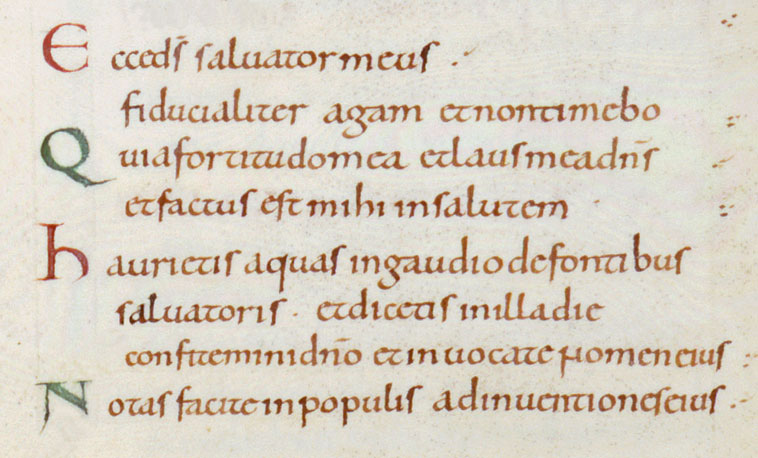
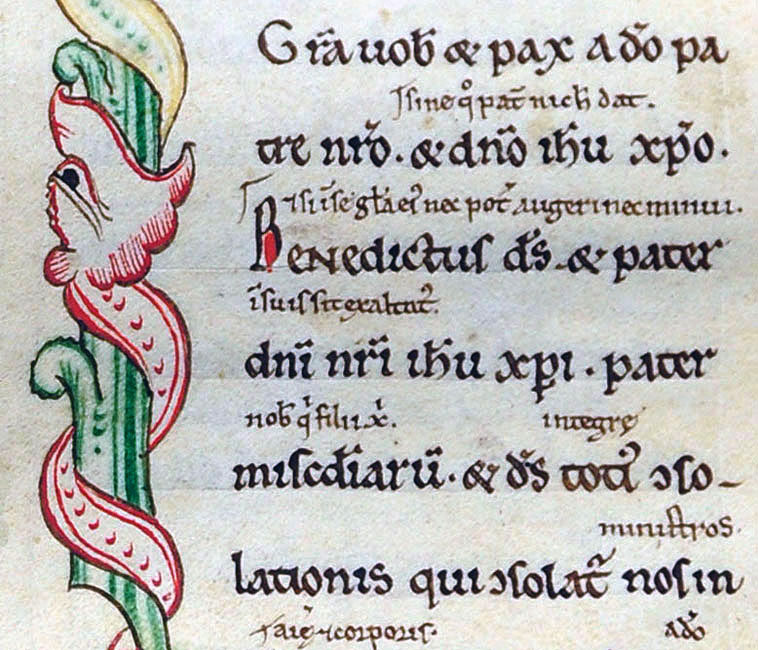
From the tenth century onwards, we find Anglo-Saxon square minuscule, named after the square proportions of letters like n, u and a. At the end of the tenth century, Caroline minuscule was introduced but only used for texts written in Latin, while Insular minuscule was maintained for texts in Old English. In some Anglo-Saxon charters, this results in extensive script-switching when boundary-clauses are in Old English, while the rest of the charter is in Latin.
Further reading:
Stokes, Peter A. 2020. ‘Insular Script.’ In: The Oxford Handbook of Latin Palaeography, ed. Frank T. Coulson and Robert G. Babcock. New York: Oxford University Press. 213-233.

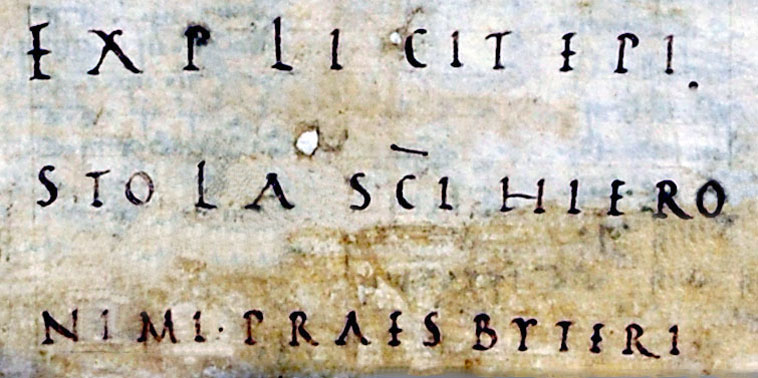
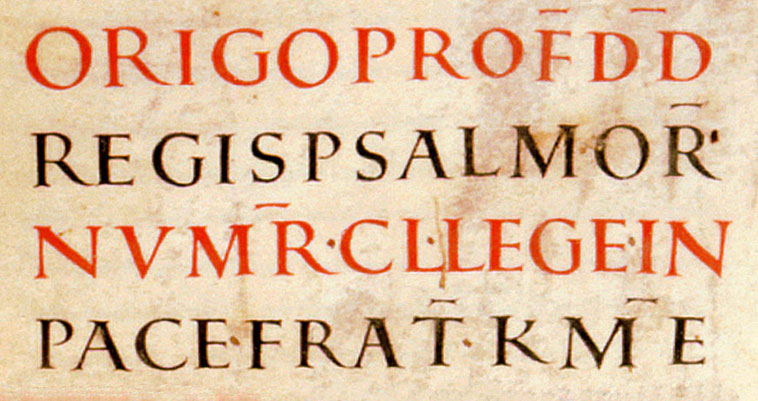 Capitalis quadrata, around 830
 Capitalis rustica, around 830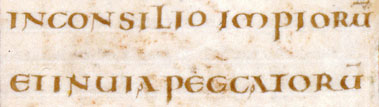
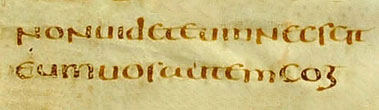
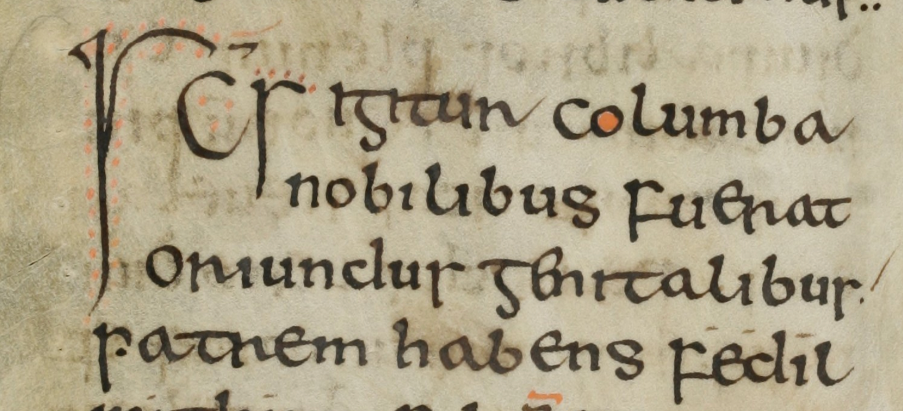 Insular minuscule, Adomnán’s Vita Columbae (Iona, c. 688-713). The beginning of the paragraph is highlighted by diminuendo, which consists of a larger letter followed by increasingly smaller ones, a feature typical of early Insular manuscripts (Schaffhausen, Stadtbibliothek, Gen. 1, p. 4;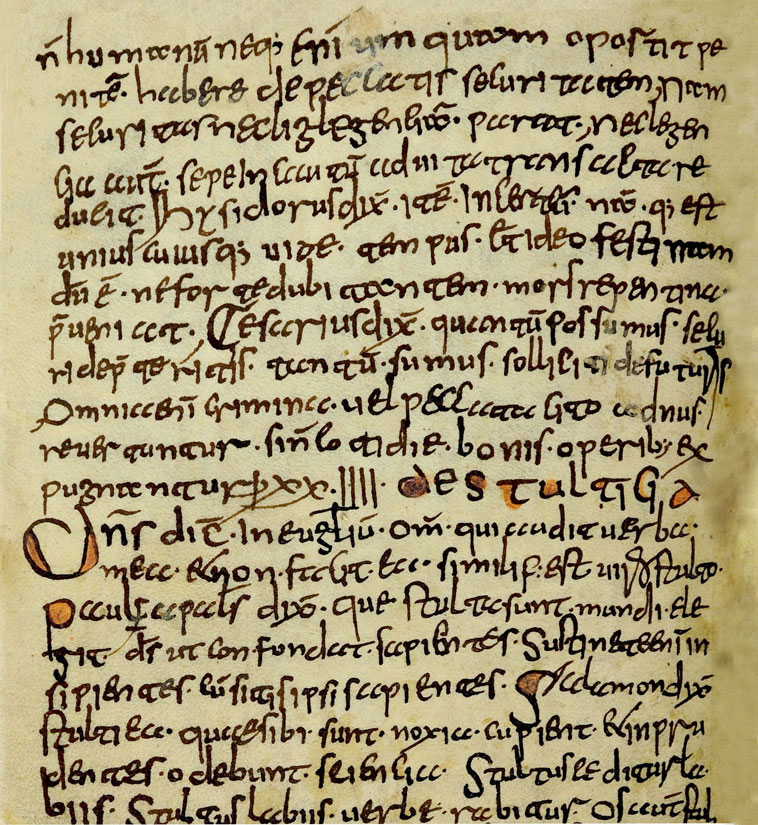
 Late Caroline Minuscule
 Early Gothic Minuscule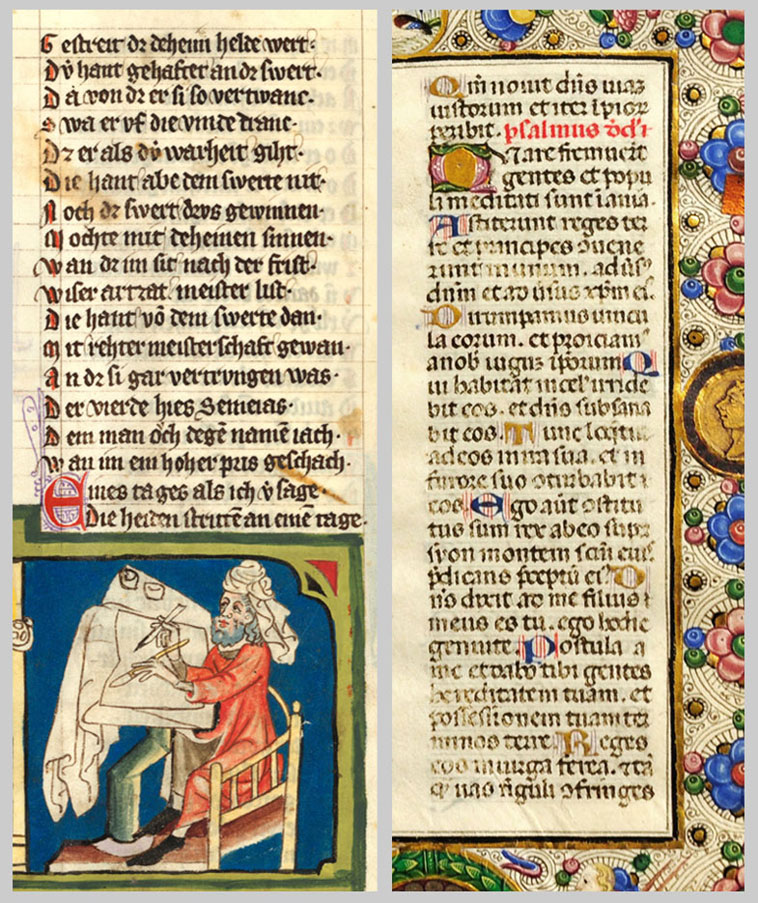
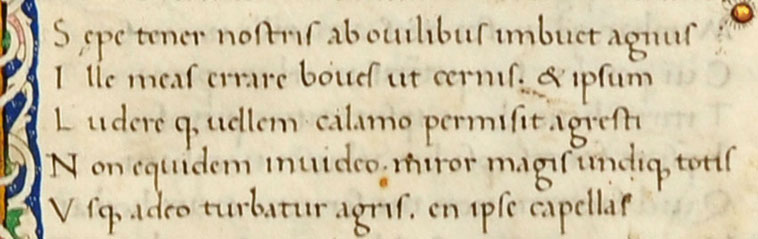 Humanist Minuscule